As we approach or make our way through middle age, many of us ask some difficult questions of ourselves: Are we truly living the life our earlier selves envisioned? What dreams, or great loves, did we abandon–or not even give a real chance? This perceptive, emotionally complex, and often-heartrending novel grapples with these questions and more, while also suggesting that new possibilities aren’t just for the young.
Falling in or out of love
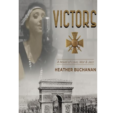
To my mind, Victors is the perfect historical novel, weaving together richly developed characters, a compelling plot, and a solid grounding in historical details. Together, these elements bring important aspects of World War I history to life. They also make for a fast-paced, entertaining read.
The novel’s main character is David Pierce, a sergeant in the 369th Infantry Regiment of the U.S. Army, which is fighting for the Allies in World War I–era France. (The 369th–made up almost entirely of African American soldiers and also known as the Harlem Hellfighters–did indeed serve in the war, to great distinction.) Because black soldiers are barred from serving with white soldiers in the U.S. Army, David and his men fight with the French, who welcome their support without reservation.
In the Acknowledgments section of this deeply felt and thoughtfully crafted book, the author, Beth Kephart, writes: “Tomorrow Will Bring Sunday’s News begins with truth. It extends through fiction.” The truth consists of fragmented details of the life of her grandmother, Margaret Finley D’Imperio, who died on October 30, 1969, when Kephart was nine. “She was the great love of my life,” Kephart writes. “She was a mystery.”
Kephart observes that decades after Margaret’s death, her brother arrived one Thanksgiving with “a box that included a handful of long-lost pages–family genealogy, notes from my mother’s cousin. … My Aunt Miriam’s few spare pages suggest the contours of my grandmother’s life”–for example, her favorite song and her employment at the Fleisher Yarn Company in Philadelphia. Yet at the time of the box’s arrival, so much about Margaret remained unknown, a deficiency that Kephart overcomes, to great effect, in the pages of Tomorrow Will Bring Sunday’s News.
Kephart immerses us in the vividly imagined life of Margaret (known mostly as Peggy in the book) and in scenes from Philadelphia at the time of the First World War, when Peggy was a teenager and at a turning point in her life. In the process, Kephart makes us care deeply about Peggy’s loves, dreams, and fears, creating a work that stands as a profound gesture of love for both her grandmother and the city of Philadelphia.

For some time, I’d been looking forward to reading this forthcoming collection of stories, which were co-authored by Kim Magowan and Michelle Ross. Having finished an advance copy of the collection, I’m delighted to highly recommend it. With dark humor, wit, and a sharp eye for human foibles, the stories explore what makes every kind of human relationship–from the ones we don’t choose to those with siblings, romantic partners, and children–challenging. It also considers why we seek connections nonetheless, and how we try to make meaning from even the messiest and most complicated entanglements.
Gerry Wilson is a seventh-generation Mississippian, and she says of That Pinson Girl, “In this novel I return to the myths of my childhood and the rural landscape of north Mississippi. I was born in Pontotoc, a little town nestled in the red clay hills of north Mississippi, thirty miles from William Faulkner’s Oxford and far from just about everywhere else.” Wilson’s prose style is straightforward, but the questions and complexities that run throughout That Pinson Girl will be familiar to those who have read Faulkner. It is appropriate that an early draft of the novel was a finalist in the Faulkner-Wisdom Writing Competition.
As we approach middle age, it’s not uncommon for us to take stock of our lives and feel disappointment–with the choices we’ve made (or haven’t been able to make) or with where we find ourselves in terms of our relationships, our careers, or our mental, physical, spiritual, or material well-being.
In this reflective, thought-provoking novel, the main character, Polly Wainwright, finds herself in just such a place. Yet in a refreshing turn, her dissatisfaction with her life becomes a sort of engine, driving her to discover new possibilities for herself. In the process, she ends up unraveling a mystery: about a man and a place she’d encountered, and been deeply affected by, years before. All of these elements make for an engaging, richly rewarding read.