
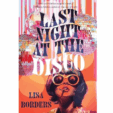
I’ve long been a fan of escapist entertainment, never more so than in these deeply troubling times. So I was delighted to learn about–and read–Last Night at the Disco, a rollicking and hilarious thrill trip helmed by anti-hero extraordinaire Lynda Boyle. Lynda’s core desire is to leave her New Jersey hometown behind for good and to escape once and for all to New York City. She imagines that, once there, she’ll assume a central place in the East Village poetry scene and party for as many nights as she’d like at her beloved celebrity-magnet disco, Studio 54. These dreams are exceeded only by the size of Lynda’s ego, which is in constant need of feeding.
Although this novel, told entirely from Lynda’s point of view, delivers much-needed escapism, its pleasures are far from simple thanks to its insider perspective on her constant, and often brilliant, scheming. To say that she’s a beauty with brains is a gross understatement. It would be more accurate to say that she’s a beauty with war-room-level strategizing powers, and she deploys these powers ruthlessly.
The story is presented as an extended, aggrieved email from Lynda to Jann Wenner, co-founder of Rolling Stone magazine. The novel begins with the subject line of the email: “Correction requested re: ‘Aura Lockhart Inducts Johnny Engel into Rock & Roll Hall of Fame,’ Rolling Stone #1326, April 2019.” Aura Lockhart is a former student of Lynda’s, and they first met in 1977, when Lynda was teaching eighth grade at her old junior high school in “that waterlogged hiccup of a town,” Keyhole, New Jersey, having put aside her “dream of achieving fame as an East Village poet” (only temporarily, she was sure). For her part, Aura eventually achieves renown of her own by, in Lynda’s disparaging words to Wenner, “commodifying her feminist rage ballads.”
At the beginning of her email, Lynda pushes back against a suggestion made by the Rolling Stone article: that according to Aura, Lynda “nearly destroyed” Johnny Engel’s career as a musician. Lynda writes, “Without me, neither Aura nor Johnny would have the fame they now enjoy.” From here, she takes her story back to 1977, when Aura, a recent transplant from New York City, shows up in Lynda’s classroom at Keyhole Junior High School.
From Aura’s first day in class, it’s clear that she’s an outsider, and though she becomes the target of an especially persistent bully, she pushes back against the nastiness and carries herself with a sort of confidence that Lynda admires. Also, when responding to Lynda’s assignment that students write a poem, Aura displays defiance and originality, something Lynda finds commendable, especially once she learns that Aura is the daughter of the recently deceased Augustus Lockhart, a “poetry god” (in Lynda’s words) and one of a number of East Village poetry scenesters Lynda had slept with.
One of the many humorous threads running through the novel is that Lynda is repeatedly called to the principal’s office to respond to one allegation or another. (She almost always finds a way to undermine both the allegations and the principal, with her looks and her two-steps-ahead scheming, making these scenes a lot of fun to read.) When Lynda is accused of caring more about poetry than about her students, the principal suggests a way to address this imbalance: that Lynda befriend a student who might need more attention. With relish, Lynda sets her sights on Aura, planning to introduce her precocious student to the “glittering world” of New York City that Aura’s father “could no longer show her–to poetry and music and, of course to Studio.” By this, Lynda means Studio 54, her favorite night spot in the city and the site of many outrageously hilarious scenes in the novel, several of which involve sex or snorting coke, or some combination thereof.
But for Lynda, everything is transactional, and her attempts to befriend Aura have nothing to do with wanting to be a better teacher, or a better person. Instead, she reflects that “Aura, with the contacts bestowed upon her by her paterfamilias–surely Allen Ginsburg, or someone of his ilk, was her godfather!–could help restore me to my rightful place in the poetry world.”
In time, Lynda learns that Aura is a budding singer-songwriter, contributing to her belief that the two of them share a special bond as artistic geniuses “banished” to New Jersey. When Lynda learns that Aura has an open-mic gig at a local club, where Lynda once read her own poetry, destiny seems to be calling. Lynda accompanies Aura at the gig, hoping to strengthen their bond. But something quite unexpected happens at the club: A beautiful man takes the stage with his guitar and transfixes the audience with three also-beautiful yet mournful songs. This man, Johnny Engel, also transfixes Lynda and Aura and ends up changing the course of both of their lives. (As an aside, Johnny’s renown grows after he forms a band named the Glow Worms, which despite its short life becomes highly influential.)
To Aura, Johnny becomes a brotherly figure and mentor, helping her gain confidence in her growing musical abilities. To Lynda, he’s a serious romantic prospect–seriousness being an exceedingly rare thing when it comes to her and men. In romantic relationships, novelty is key to Lynda, and most of the men she dates or has flings with seem as disposable to her as so many cocktail napkins. This all changes with Johnny, and her determination to make sure that he’s as attracted to her as she is to him is one of the engines that drives the novel forward–so is Lynda’s determination to ascend in the East Village poetry scene, ideally with Aura’s help.
Not wanting to give too much away, I’ll just say that despite this determination, and often because of it, Lynda doesn’t always get what she wants, a reality that chafes against her sense of entitlement, and against her boundless ego. And when she doesn’t get what she wants, she acts out, sometimes leaving destruction in her wake.
In what feels like a last-ditch effort to reel in Johnny–or at least make him thankful for her perceived support of him and his career–Lynda helps to score a gig for him at Studio 54. But on this front, things don’t go as planned for Lynda, or for Johnny, turning both of their lives upside down.
It’s important to note that the novel moves between Lynda’s New Jersey/New York City past and her present in some distant, undisclosed location, where she lives with her “hubby.” They are in hiding because of her husband’s criminal past–and possible criminal present. Although the story of their relationship plays out in the background of Lynda’s conniving and pleasure-seeking in 1977-78, it is one of the great joys of the book–for one thing, because the two of them seem to form a real connection, catching Lynda off-guard at first: Up until this point, deep or lasting relationships with men haven’t tended to be her thing. More significantly, we sense that Lynda has met her true match in this man, who not only accepts her recklessly selfish behavior but is deeply charmed by it. To put it another way, these two deeply flawed human beings seem to find in each other a love for the ages, and the writing about their relationship is, by turns, witty, sharply funny, and surprisingly moving.
As for whether or not Lynda ever sets the record straight with Jann Wenner, I’ll leave that to you to discover for yourself. But having had the pleasure of following along on her many adventures, misadventures, and schemes, I will say that in the pantheon of literary anti-heroes, she deserves a Studio 54-worthy banquette–preferably, one amply provisioned with cocaine. It was loads of fun to be immersed in her world.
Would My Pick be Your Pick?
If you're interested in ________, the answer may be "Yes":■ Stories with anti-hero protagonists
■ Comic novels
■ Studio 54 and the disco era
■ The post-punk era of music