
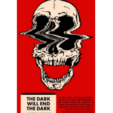
A couple of years ago, I had the pleasure of interviewing Darrin Doyle about his spellbinding horror novella, Let Gravity Seize the Dead. When I learned that Doyle’s highly praised story collection, The Dark Will End the Dark, had been released in a revised tenth-anniversary edition, I was eager to read it–and it didn’t disappoint.
The collection has been described as Midwestern Gothic, but it also delivers a generous dose of body horror, something suggested by the very titles of certain stories–for example, “Foot,” “Penis,” “Head,” Mouth,” and “Arms.” In these and other tales, the book explores the myriad ways in which the body can betray us or serve up visceral kinds of horror that are far more terrifying than anything that could be delivered by an external force.
But the collection also takes up the daily and existential struggles of characters who must deal with these betrayals and horrors. In the story ”The Hiccup King,” the protagonist, Owen, is living with the consequences of a going-on-two-years fit of hiccups, one of which was the end of his marriage. As Owen reflects, his wife “stuck it out for the first few months, but the sleepless nights, one disruptive hic! after another during her favorite television programs, during lovemaking, breakfast, lunch, dinner, family gatherings, funerals, weddings–it proved too much.”
Early in the story, one of Owen’s co-workers brings up the world-record holder for hiccuping: “Son of a bitch’s had the hiccups for fifty years, so you shouldn’t feel bad. His life’s pretty normal, from what I can tell.”
Eventually, Owen makes a road trip to visit this so-called Hiccup King, seeking to make a meaningful connection with someone who’s had to live with the same condition that he has. But what he ultimately discovers upon meeting this now frail and elderly man seems to have more to do with the vagaries of accidental fame, and how that form of celebrity can warp the desires, expectations, and day-to-day reality of those who’ve experienced it.
In the darkly comic story ”Head,” a woman is uncertain what to do after her husband’s head stops functioning–drooping “like a flower with a broken stem”–while his body remains alive. At one point, a character described as “the young doctor” recommends amputating the husband’s soon-to-be-rotten head, having advised the wife to “[t]hink of the head as just another appendage. A glorified arm.” In response, she reflects that “she didn’t marry him for conversations with his arm.”
An older doctor tells her, “In many ways, he’s still the man you married.” Yet the wife notices a marked change in her husband: Now “he had a fire inside. His passion was directionless, untamed, and on display,” and he’s given to fits of violence and destructiveness.
One of the many things the husband can no longer do is continue working on a book about “the central trauma of his life–his father’s death in Vietnam,” work that he claimed was helping him heal. Although the wife seems to have shown little interest in this project, their daughter remains sympathetic to the endeavor, having read the book and a startling revelation in it–something that leads her to make a horrifying connection between the young doctor’s plans for her father and her paternal grandfather’s death. From here, still more horrors unfold, ones suggesting that a desire for vengeance may reside in the body as much as in the mind. As with many other stories in this collection, the series of events in this tale, although surreal, have a certain bracing logic to them, which builds and builds over the course of the narrative and leads to a stunning conclusion.
One of the more tragic stories in the collection, “Sores,” highlights the alienation and isolation that can arise from a particular form of bodily betrayal: unsettling and inexplicable changes in one’s physical appearance.
At the start of the story, the most immediate problem facing the protagonist, Jim, seems to be his ex-wife’s demand for custody of a fifty-gallon aquarium of tropical fish that had been a wedding gift from her parents. The fact that she’d cheated on Jim makes him feel that he has a right to the fish, something she refuses to accept.
Shortly, though, Jim is faced with another, far more significant challenge: sores that begin appearing all over his body, each of them a dry, white patch of skin ringed by a band of blood. The doctors he consults aren’t able to explain the sores, or offer any treatments that can banish them. Frustrated and troubled, Jim takes to watching the tropical fish: “It distracted him.” And soon he discovers that “[h]e needed to get drunk like he needed to breathe.”
In time, Jim becomes largely isolated, somewhat by his own choice but also by others’. For example, colleagues at the moving company where he works keep as far away from him as possible, seeming to believe the sores are contagious. To his parents, Jim “was no longer their son, he was their diseased son.” Eventually, the sores become so pervasive that they seem to cancel out even memories of his former appearance: “In the mirror, he had stopped seeing himself; he only saw the sores.”
More and more, Jim takes to his couch, from where he watches the tropical fish “do their weightless dance.” Reflected in the tank’s glass is his face, ever more covered with sores. In time, Jim notices a parallel physical deterioration in the fish, which doesn’t abate though he feeds them and cleans their tank. The question that looms in the background of Jim’s story, and the story of the dying fish, is Why? The priest he (reluctantly) consults at one point in the story may offer the most reasonable answer:
The surreality of this and other stories in this collection brings the all-too-real existential questions, needs, fears, and vulnerabilities that we all live with into sharper, more vivid relief. Each tale offers much to ponder and haunts in its own particular way.
Would My Pick be Your Pick?
If you're interested in ________, the answer may be "Yes":■ Surreal or fabulist fiction
■ Gothic literature
■ Body horror, or horror stories in general