
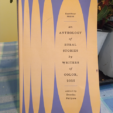
This anthology, now in its third edition, offers a variety of captivating tales, from the darkly inspiring to the delightfully strange. Collectively, the stories explore a range of themes–for example, the importance of community and familial bonds, the power of resistance, the essential nature–and fragility–of love, the long shadow of loss, and the burden of feeling like an outsider, in society at large or within one’s own family or social circle.
Despite the anthology’s title, not all the stories are set in the countryside. As guest editor Deesha Philyaw notes in her introduction, “I wanted stories that reflected an expansive view of ‘rural.’” As she observes, the stories cover “a wide berth,” featuring such settings as a Tampa trailer park, farms, an Osage Indian reservation, a cadaver field-research station, and a mansion on the “forested edge of New Jersey.”
I found every story in this collection to be thought-provoking and entertaining, and at times, darkly funny or deeply moving. But in the interest of going more deep than wide in this review, I’m going to focus on just a few stories that I found especially striking.
“Wild Hogs on the Backside of Yonder” tells the story of River, an elderly Black landowner who wakes one morning to find that his two beloved black labs have been killed, and that his field of greens and black-eyed peas has been trampled and also strewn with the remains of three slaughtered hogs. The strongly suspected culprit: a white family known as the McGrangers, who’ve become “infamously known all around West Alabama for pushing people off their land for one reason or the other.” The McGrangers seem to target old and ailing landowners like River, and they are believed to have been responsible for the death of a neighbor who’d refused to sell his land to them for a dollar an acre.
“Wild Hogs” works on so many levels. First, it’s an uplifting story of a community rallying around a neighbor who’s in danger. As soon as they learn of the threat to River, his friends come to his aid, bringing rifles and pledges to help him look out for approaching McGrangers. And while they’re on duty, one of the friend’s wives brings them Sunday dinner.
Second, “Wild Hogs” is an inspiring story of resistance, satisfying for all the heart and determination that River and his neighbors put into trying to deter the McGrangers, and ultimately to defeat them. In addition to looking out for intruders with his friends, River makes masks out of the heads of the slaughtered hogs, “like the work of an untrained slasher artist.” Then, he and his friends place the masks on poles in the field in front of his house, creating a scene of scarecrow-like figures that could be straight out of a horror movie. In a bit of comic relief, one of the characters describes one man’s (Jankin’s) reaction to the sight:
Last but most certainly not least, the story provides a vivid and contemporary portrayal of a phenomenon all too common in our country since it was settled by white people: the theft of land populated or stewarded–or owned outright–by Black and indigenous people. By the end of the story, there is no doubt that River is willing to die in the fight for his land, having experienced a nearly fatal encounter with two McGranger henchmen. In the final scene, which has a now-solitary River looking out for intruders from his front porch, rifle in his lap, we sense both the long odds he’s facing and his determination to throw everything he has into the fight that seems certain to come.
The story “Field Methods” is set in a very different kind of landscape: a grassland where cadavers are deposited so that researchers can study their decomposition, which has applications for criminal investigations. As part of a college internship, the main character, Miriam (a.k.a. Miri), is helping a doctoral student track how clothing affects the ways in which vultures feed on a decomposing body in the grassland.
Miri seems to coexist with the dead on two levels. One one level, she’s engaging with her work with the cadaver-subjects of the research project. On another level, she’s mourning the loss of her father, who went missing when Miri was eleven and is presumed dead. This loss haunts her throughout the story, and in one especially moving passage, she reflects:
Miri is hard on her mother, Pilar, who is flawed in the usual human ways but seems to be trying to do her best by her daughter–something Miri acknowledges. And unlike Miri’s father, Pilar is physically present for her daughter, not merely an assortment of memories, or a ghost. Yet, paradoxically, and seemingly by way of his absence, Miri’s father–and her memories of him–appear to have more of a hold on her than Pilar could ever manage. Through Miri’s reflections on her father and her other relationships, “Field Methods” explores the importance of being and feeling loved, even if those feelings are part of our distant past.
In addition to delving into the long-term effects of absence and loss, the story explores, with nuance and feeling, Miri’s awakening to her queerness. When her straight roommate, Ashleigh, asks to “go see the bodies,” needing a distraction from a breakup with her boyfriend, Miri reluctantly agrees to the request, even though she could get fired from her internship if Ashleigh’s presence at the research site were to be discovered.
In an exceptionally beautiful passage near the end of the story, Miri reflects on the sight of Ashleigh observing a dead body from within the cooler where it has been stored:
The anthology closes with the delightfully strange story “Princeton,” featuring a boy whose thieving impulses eventually lead him out on a ledge, literally and figuratively. That boy is Jason, who along with his older brother, Tommy, has been sent to live with a doctor, Paul Hrisak, and Paul’s wife while their father looks for a job. The plan is that once their father secures employment, he’ll be able to bring his father to the United States from their home country: South Korea. (The boys’ father got to know Paul when Paul was visiting Busan, South Korea, as part of a university exchange program, and the father served as his guide and interpreter.)
Although the Hrisaks are welcoming and kind to Jason and Tommy, the boys never seem fully at ease in their new environs, which is understandable considering that they are now living with virtual strangers, whose grand home in Princeton, New Jersey, seems part country club and part museum. As Jason observes, there is also a cultural divide:
Soon, Jason takes to filching “like a magpie,” stealing items that, at first, appear to have little material value–for example, a Ticonderoga pencil, some photographs, paperclips, and a marble. The thievery comes, in part, from curiosity. As Jason observes:
As the thievery progresses, it also seems possible that it might be an attempt by Jason to gain some measure of agency in a situation over which he has no control.
Eventually, Jason spots a blue-and-white striped bowl atop a display case in Paul’s study. Noticing Jason’s interest, Paul explains that the bowl is said to be a relic left by the Anasazi, American Indians who lived in the Mesa Verde, near New Mexico, before they vanished mysteriously. He also says that in most cases, when the makers of such bowls died, their kinsmen smashed their handiwork to set the makers’ spirits free. “This may be the only surviving spirit bowl,” Paul tells Jason, describing the object as the “capstone” of his collection of artifacts.
Given Jason’s fascination with the bowl and his propensity for thievery, you might have a sense of where the story is going. Nonetheless, the impulse that leads him to rush the bowl to the edge of a roof–the Hrisaks and Jason’s brother, and now also his father, in pursuit–brings the story to a surprising and revelatory end. The final passages suggest that Jason’s time in Princeton has marked a turning point in his life and in the way he sees himself and his family.
Would My Pick be Your Pick?
If you're interested in ________, the answer may be "Yes":■ Stories about resistance and fighting against discrimination
■ Stories about family conflicts and bonds
■ Stories about coping with loss
■ Stories of self discovery